Manchester Royal Infirmary
Blow OutManchester Royal Infirmary is the first major medical setting in the investigation into the ricin attacks: Ronnie O’Neill dies there, and the clinical account of his illness helps turn a suspicious death into a poisoning inquiry. Later, the hospital becomes part of the response to further attacks, receiving antidote stocks and treating Heather Rand after police warnings enable rapid intervention. Across these episodes, it links medical observation, forensic interpretation, and the practical limits of emergency treatment.
Role in the Investigation
Joanne Stuart is sent to Manchester Royal Infirmary after Greater Manchester Police ask for help with a suspicious death in the Critical Care Unit. She is initially told to attend alone because Max Nailor and the rest of the team have been assigned to another operation, though she can draw on National Crime Agency resources. The hospital is therefore not simply a place where evidence is collected: it is where the investigation begins under constrained staffing and with the cause of death still unknown.
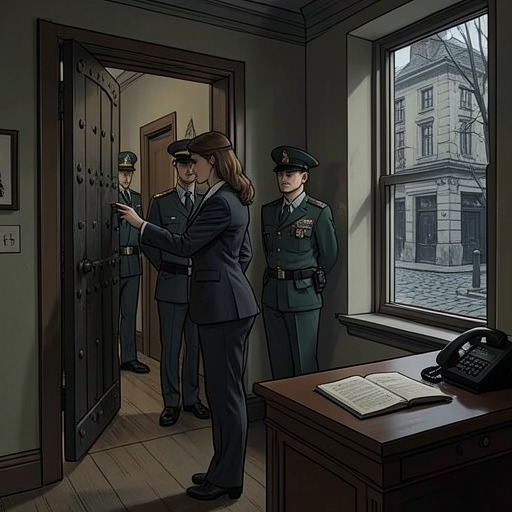
When Joanne and Gordon Holmes arrive, they find a crowded reception hall in which officers and hospital security are trying to manage five angry men. Gordon uses his warrant card to ask for Ronald O’Neill, who has been admitted to Critical Care. The tense entrance contrasts with the controlled clinical process inside: the hospital is handling both a medical emergency and the disruption surrounding a death that has already drawn the attention of O’Neill’s family and associates.
Ronnie O’Neill’s Death and the Clinical Account
The hospital staff explain that O’Neill was brought to Accident and Emergency with a developing set of symptoms, including respiratory irritation, a sore throat, congestion, chest tightness and skin irritation, followed by vomiting and diarrhoea. He was severely dehydrated, had very low blood pressure and difficulty breathing, and began suffering seizures after transfer to the Acute Medical Unit. As multiple organ failure became apparent, he was moved to Critical Care and isolated in a side room. Despite treatment by four consultants and specialist nurses, his liver, spleen and kidneys had stopped functioning; he was pronounced dead at 8.16 a.m.
The clinical sequence gives the investigation a chronology of deterioration but does not, by itself, identify the poison. A consultant, Dr Okafor, distinguishes the observed course from what he would expect if the toxin had been ingested: ingestion would produce a markedly different early pattern, including gastrointestinal symptoms and swallowing difficulty. He says the eventual outcome could still be multiple organ failure. The distinction matters because it directs attention away from a simple account of poisoning by swallowing and toward other possible routes of exposure.
The medical staff also place the likely exposure earlier than the hospital admission. O’Neill’s family believed the incident had occurred on Friday morning while he was playing golf, three days before Gordon asks whether earlier treatment might have saved him. Okafor cannot answer that without knowing the exact toxin and quantity, but he concludes that whoever caused the exposure almost certainly intended a prolonged and painful death. The hospital’s evidence thus establishes both the severity of the illness and the limits of what can be inferred from clinical observation alone.
From Suspicious Death to Ricin Evidence
The initial public account of O’Neill’s death is deliberately more cautious than the later scientific interpretation. At a press briefing, the police state that a fifty-three-year-old man died at the hospital after developing total organ failure and confirm that the death is being treated as suspicious. The investigation remains ongoing, and officials limit what they disclose. This controlled announcement marks the shift from a death under medical care to a criminal investigation without yet naming a cause.
Later, Sir James Flatman explains why the post-mortem findings are consistent with ricin poisoning by absorption through the skin. He describes the toxin’s effect on the body’s ability to produce proteins and the ensuing breakdown of major organs and the central nervous system over two to five days. He also identifies evidence at the puncture site consistent with an allergic reaction, while stressing that further analysis is needed to distinguish ricin from other poisons that could produce similar effects. The hospital’s observations and the post-mortem interpretation together build a case, but neither makes uncertainty disappear at once.
The link between the hospital evidence and the attack method becomes stronger when a specialist assesses a pellet recovered in the investigation. On the basis of O’Neill’s post-mortem findings, the specialist says they are categorically consistent with ricin poisoning and that only a fraction of the amount the pellet was designed to carry would have been sufficient to explain his death. The clinical record has therefore become more than a description of a patient’s decline: it is a reference point against which the physical evidence of the suspected delivery method can be tested.
Antidote and the Later Attacks
After two attacks, Joanne asks whether antidote can be made available in case further victims emerge. A batch of twelve doses has already been sent by courier to a toxicologist at Manchester Royal Infirmary who is registered with the National Poisons Information Service. Joanne resents learning this only after asking, since lives are at stake, but the delivery means the hospital is prepared to respond. That preparation has a critical limitation: the antidote is most effective within the first twenty-four hours, while the effects of a lethal exposure can become irreversible after only a few hours, even though death may take days.
When Heather Rand is brought to medical attention, the police response connects her directly to the antidote held at the hospital. Joanne asks for a dose to be sent over, only to learn that her colleague has already arranged delivery and that it has been administered. Heather is moved to a private room on a ward. The ward sister reports that she is doing well considering the circumstances: the pellet has been removed under local anaesthetic, the wound flushed, and her dislocated shoulder reset before the antidote was given. Clinicians will monitor her for complications, but the prognosis with such early treatment is generally favourable.
Heather’s treatment supplies the starkest contrast with O’Neill’s death. At the hospital, his deterioration had ended in fatal organ failure after several days; in Heather’s case, an earlier police alert helps the emergency department recognize what it is dealing with, remove the pellet and begin treatment. The hospital cannot undo the danger created by the attacks, and the antidote has a narrow window of effectiveness, but its presence makes a different outcome possible. Manchester Royal Infirmary consequently stands at the intersection of the investigation’s two central tasks: establishing how the first victim died and acting quickly enough to protect those who may be next.